Coding agents, with discipline.
Yulius runs your Claude Code tasks on your own server and makes each one work the way a careful engineer would: a spec first, a plan you can follow, its own branch, tests and a pull request. Start many at once, check in from your phone, and build together as a team.
Self-hosted. Open source soon.

If you build, but aren't an engineer by trade
Describe what you want in plain words. The agent picks the technology and writes down why, plans the work, adds tests and keeps the project consistent from one task to the next. What you build keeps working as it grows, and you don't need to know frameworks or git to get there.
If you already run Claude Code all day
Stop juggling terminals, worktrees and half-remembered context. Every task gets its own branch and worktree, starts with the whole project's context, and lands as a pull request with its checks. Run several side by side and let them agree who changes what.
How a task runs
-
Describe the goal
Write what you want, like “add a checkout with Stripe test keys”. In goal mode the agent keeps working until the goal is met.
-
A spec comes first
Before touching code, the agent writes down what the task should do, in the repository, next to the code.
-
A plan you can follow
The plan becomes steps above the terminal, so you see where the task is and what's left. A plan with missing parts goes back to the agent.
-
Its own branch
Every task works in its own branch and worktree, so tasks running side by side never trip over each other.
-
Tests and a pull request
The work arrives as a pull request with its checks, ready for you to review.
-
You decide what ships
Merging and going live are your actions. Yulius never infers them from what the model writes.
The discipline models don't bring on their own
Left alone, coding agents forget yesterday's decisions and take shortcuts. Yulius keeps every project in one documented shape that each new task reads before it starts.
A spec for every task
What the task should do, kept in the repository.
Plans with steps
Every change to a step records who made it and when.
Decisions written down
Technology choices and their reasons, next to the code.
Architecture and diagrams
Kept in the repository and kept current.
Context for every new task
The project summary, decisions, recent changes and what other tasks are doing.
Git hygiene
Feature branches and pull requests. No direct pushes to production.
Many tasks at once, without collisions
Start the next task while the last one works. Each runs in its own worktree. Tasks see what the others are doing, message each other and agree on who changes which files. Anything waiting for you rises to the top, under Needs you.

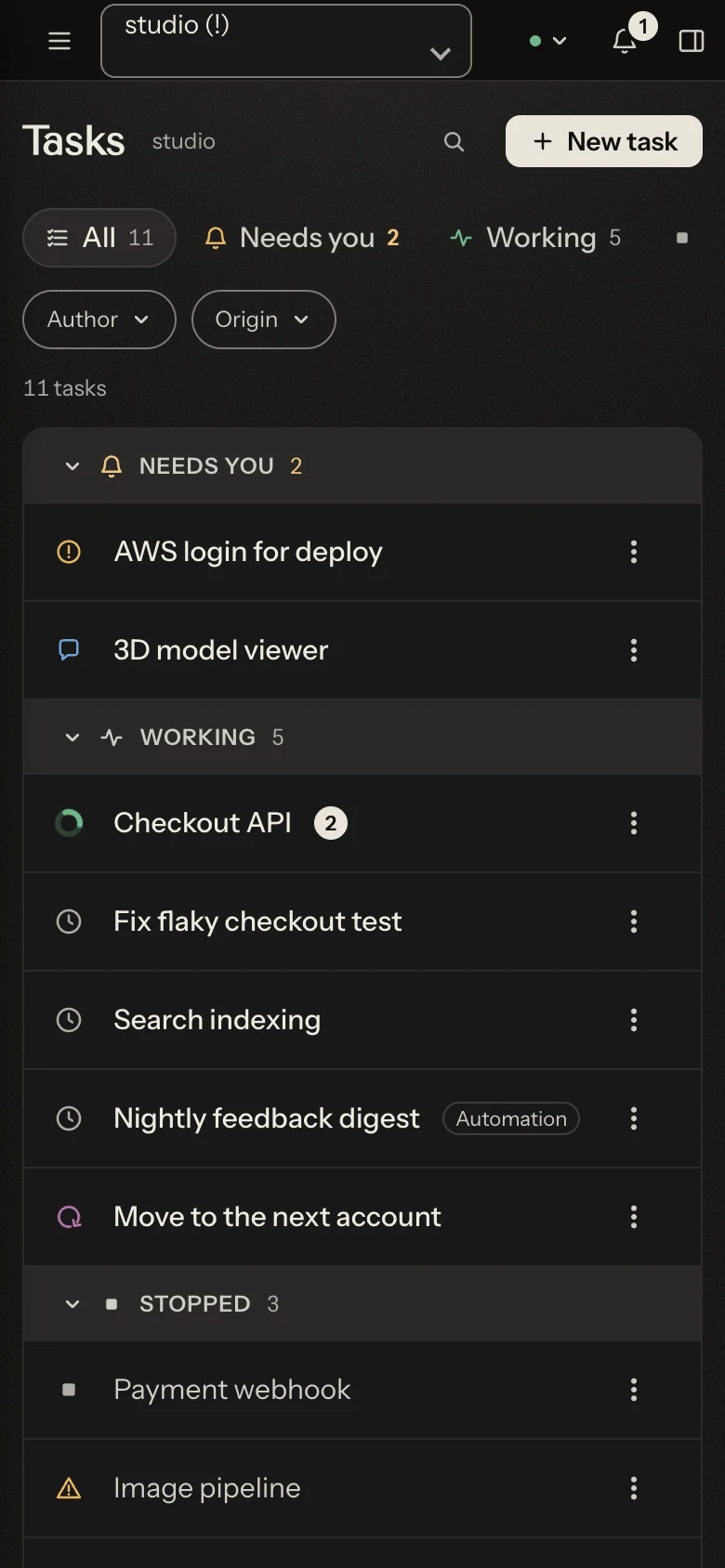
Close the laptop. The work goes on.
Tasks run on your server, not on your machine. Open Yulius in any browser, including your phone's, to read a task's terminal, answer a question or send the next instruction. Sessions survive a dropped connection and a server restart.
From task to production, in plain sight
The Git page shows what is being built, what waits for review and what is live, with every pull request's checks. Each project has its own delivery path, straight to main or through a dev branch and environments, and merging stays your call.

Set up once, for the whole team
GitHub sign-in and permissions
People sign in with GitHub and see and do only what their repository access allows.
Pick up anyone's task
Anyone with write access can continue a stopped task, with its whole history.
Skills, MCP servers and workflows
Add them once and every Claude Code session gets them. Skills switch on when they're relevant.
Automations
Schedule tasks, like turning yesterday's customer feedback into fixes every morning.
A browser your agents share
Each project has a real browser that people and agents use together. You see where the agent clicks, and it can ask you to sign in.
Editor, shell and dashboard
A built-in editor and shell for quick changes, and numbers on tasks, time and tokens.
The work runs on your server, day and night
Your laptop and phone are only for giving instructions and checking in. Close them and every task keeps going. Each project lives in its own sealed sandbox, so one project's code and files never reach another.
Runs 24/7
Tasks keep working on your server while your laptop sleeps, and carry on after a dropped connection or a restart.
Steer from anywhere
Give a goal, answer a question or approve a merge from a laptop, a phone or any browser. Nothing runs on your device.
Sealed per project
Every project gets its own sandbox, files, browser and agents. One project can't see into another.
Questions
Do I need to be a programmer?
No. You describe what you want; the agent makes the technical choices and writes them down, and Yulius makes sure the specs, plans, tests and pull requests happen. Knowing some code helps you review the work, but it isn't required.
Is it a chat window on top of Claude Code?
No. Every task is Claude Code's own terminal interface, running on your server. Your slash commands, model and effort settings work as they do on your laptop. Yulius adds the structure around it.
Where does it run?
On your own Linux server or virtual machine. Yulius is a single program that serves the web app. You connect your GitHub organization or account, and your team's Claude accounts.
Which coding agents does it support?
Claude Code today: every task is one Claude Code session. Codex and OpenCode are coming soon. Want another coding agent? Write to bartek@yulius.dev.
Is it open source?
It will be. We're preparing the public repository. Ask for early access and we'll tell you when it's out.
Is Yulius made by Anthropic?
No. Yulius is built by the Quartio team and is not affiliated with or endorsed by Anthropic. Claude and Claude Code are trademarks of Anthropic.
“What stands in the way becomes the way.”
Build with Yulius early
Yulius is in early access. Write to us and tell us what you'd build with it.
Get early access